



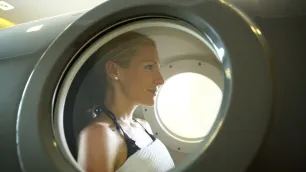
This informal CPD article ‘The Rise of Mild Hyperbaric Oxygen Therapy at Home’, was provided by Oxygens, a supplier and manufacturer in the field of Mild Hyperbaric Oxygen Therapy.
Hyperbaric Oxygen Therapy (HBOT) has become an increasingly popular treatment for a variety of medical conditions and general wellness over recent decades. The rise of mild HBOT, particularly the use of portable, home-based devices, is changing how people access this therapy. This article will explore the roots of HBOT, its development over the years, its temporary hiatus during the war, and the resurgence of HBOT in recent years, with a particular focus on mild HBOT for home use.
Understanding HBOT
Hyperbaric Oxygen Therapy involves the inhalation of pure oxygen within a pressurised chamber. This treatment increases the amount of oxygen in the blood, promoting healing, tissue repair, and boosting the immune system. The basic principle of HBOT relies on the fact that under pressure, oxygen can dissolve in blood plasma and reach tissues that would otherwise not receive enough oxygen, especially in cases of injury or disease (Song et al., 2024).
The Roots of HBOT
The foundation of HBOT can be traced to the 17th century when the English scientist Robert Boyle conducted experiments that demonstrated the relationship between pressure and gas volumes, known as Boyle’s Law. This principle laid the groundwork for future work involving oxygen under pressure (Boyle, 1660).
Fast forward to the late 19th century, when Dr. George Crile, an American physician, began experimenting with hyperbaric chambers to treat a variety of conditions, including infections and wounds. Crile’s efforts to develop a chamber that would safely allow oxygen to be administered at high pressure were foundational to what we recognize as modern HBOT (Zhou et al 2023).
The 20th Century: Progress and Challenges
The early 20th century saw significant advances in the use of HBOT. Following its initial applications in treating decompression sickness, a condition affecting divers who ascend too quickly, researchers began to explore the use of HBOT for other conditions, such as carbon monoxide poisoning, burns, and severe infections (Feldmeier, 2003). By the 1950s, the therapy began to gain wider interest within medical circles.
The Decline During War and Post-War Periods
The decline in the development of HBOT during and after the war was due to several factors, including the reallocation of resources to support the war effort, as well as limited recognition of the therapy's broader potential. Although HBOT continued to be used for specific conditions like decompression sickness, the full medical potential of hyperbaric therapy was not realised on a large scale until decades later (Harch, 2025).

The introduction of mild HBOT
The Resurgence of HBOT in Recent Decades
Over the last few decades, there has been a resurgence in the use of HBOT, led by advancements in technology and growing research into its broader health benefits. In particular, studies have demonstrated HBOT's potential in treating conditions such as chronic fatigue syndrome, fibromyalgia, traumatic brain injuries, and post-stroke recovery (Ablin et al, 2023; Akarasu, 2023; Cozene et al, 2020). The increasing popularity of HBOT for these non-emergency conditions has sparked interest among individuals looking to improve their general health and wellness, rather than just address medical conditions.
One of the key factors behind this resurgence is the growing body of evidence supporting the therapy’s potential efficacy in promoting cellular healing and reducing inflammation. Researchers like Boussi-Gross et al. (2013) have found that HBOT can aid in neuroplasticity, aiding repair in brain function, making it an appealing treatment option for a wide array of individuals.
The Rise of Mild HBOT for Home Use
Perhaps one of the most significant developments in recent years is the introduction of mild HBOT, which operates at a lower pressure than traditional HBOT chambers. Traditional HBOT chambers typically operate at pressures between 2 to 3 atmospheres, whereas mild HBOT chambers, which operate at around 1.3 to 1.5 atmospheres, provide many of the same therapeutic benefits while being safer and more convenient for home use.
Mild HBOT has been used in home settings due to its ability to support general health and well-being, as well as recovery from exercise and fatigue. The therapy has been shown to improve sleep, reduce inflammation, enhance energy levels, and support immune function (Zilberman Izkovich, 2022). Moreover, mild HBOT is much more affordable and accessible than traditional, high-pressure treatments, which are often only available in clinical settings.
The convenience of using mild HBOT at home has contributed to its growing popularity. Portable chambers are now widely available, with many individuals opting for home use to manage their health conditions, improve physical recovery, and promote overall wellness. While not a replacement for more intensive treatments, mild HBOT can provide benefits when used as part of a holistic approach to health.
Conclusion
The rise of mild HBOT at home is a reflection of the need for accessible, non-invasive health treatments in today’s wellness-focused society. From its early beginnings in the 17th century with Boyle’s experiments to its modern applications in treating a wide range of health conditions, HBOT has undergone a change. The resurgence of HBOT in recent decades has led to greater recognition of its potential for general wellness, and the introduction of mild HBOT for home use has provided access to this therapy. As more research is conducted and technology continues to improve, HBOT’s role in health and well-being may grow.
We hope this article was helpful. For more information from Oxygens, please visit their CPD Member Directory page. Alternatively, you can go to the CPD Industry Hubs for more articles, courses and events relevant to your Continuing Professional Development requirements.
References:
- Song et al., 2024 https://journals.lww.com/shockjournal/fulltext/2024/05000/effects_of_hyperbaric_oxygen_therapy_on_intestinal.2.aspx
- Boyle, 1660 https://www1.grc.nasa.gov/beginners-guide-to-aeronautics/boyles-law/
- Zhou et al 2023 https://pubmed.ncbi.nlm.nih.gov/37109720/
- (Feldmeier, 2003). https://www.uhms.org/images/indications/UHMS_HBO2_Indications_13th_Ed._Front_Matter__References.pdf
- (Harch, 2025). https://www.frontiersin.org/journals/neurology/articles/10.3389/fneur.2025.1536541/full
- Ablin et al, 2023; https://pmc.ncbi.nlm.nih.gov/articles/PMC10004612/
- Akarasu, 2023; https://pubmed.ncbi.nlm.nih.gov/23682549/
- Cozene et al, 2020 https://pmc.ncbi.nlm.nih.gov/articles/PMC7563917/#:~:text=In%20regard%20to%20chronic%20ischemic,brain%20metabolic%20rate%20%5B21%5D.
- Boussi-Gross et al. (2013) https://pubmed.ncbi.nlm.nih.gov/24260334/
- (Zilberman Izkovich, 2022). https://www.nature.com/articles/s41598-022-15565-0
- Dr Sarah Bishop https://www.drsarahbishop.co.uk/post/nurturing-autism-birmingham-hyperbaric-oxygen-therapy
