



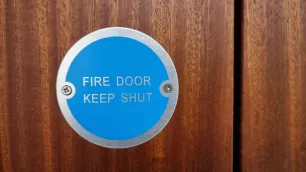
This informal CPD article ‘Transitioning from BS 476 to BS EN 1634: Building the Golden Thread in Fire Door Compliance’ was provided by Woodmarque, a Construction Education and Training organisation based in Northern Ireland.
As part of the construction sector’s ongoing commitment to safety, transparency, and accountability, the transition from BS 476 Part 22 to BS EN 1634-1 marks a pivotal moment for everyone involved in the design, manufacture, and installation of fire doors.
Across the joinery industry, this evolution can be viewed not as a compliance burden but as an opportunity to reinforce best practices aligned with the Golden Thread principle — ensuring that safety, performance, and documentation remain connected from design through construction and beyond.
Understanding the Standards
BS 476 Part 221 has long been the benchmark for testing the fire resistance of non-loadbearing elements such as doorsets and partitions. It measures two key criteria:
- Integrity (E): preventing flames and hot gases from passing through, and
- Insulation (I): limiting the temperature rise on the unexposed surface.
Under BS 476, the furnace is heated according to a standard time–temperature curve, and performance is expressed as a time rating (FD30, FD602, etc.), reflecting how long a door can resist fire.
By contrast, BS EN 1634-13 is part of a harmonised European testing framework that provides a more comprehensive and stringent assessment of fire doors and shutters. In addition to (E) and (I), it can include radiation (W) and smoke control (S) performance. Test conditions are more tightly controlled, with higher furnace pressures, dual-side exposure, and defined tolerance limits, ensuring a more robust basis for safety assurance.
Why This Change Matters Now
Although the UK Government will not make EN 1634-1 mandatory for new fire doors until September 2029, preparing now is essential. The new framework will eventually replace BS 476 as the accepted means of demonstrating compliance. Transitioning early allows manufacturers, contractors, and specifiers to align with the future standard — avoiding retrospective adjustments and ensuring that buildings designed today remain compliant tomorrow.
This proactive approach also reflects the Golden Thread ethos: embedding accurate, accessible information throughout a building’s lifecycle. By adopting EN-tested products and maintaining detailed digital records, stakeholders contribute to a verifiable chain of safety evidence — from specification and fabrication to installation and ongoing maintenance.
Digital Records: QR Codes and RFID Tagging
As the industry moves toward greater traceability, technologies such as QR codes and RFID tags are becoming integral to best practice.
- QR codes provide quick access to inspection records, installation data, and maintenance logs, supporting the “responsible person” in demonstrating compliance.
- RFID or NFC tags, which can be embedded in the doorset or frame, offer enhanced durability and contactless data retrieval. They link directly to digital records, ensuring the integrity of documentation even in demanding environments.
These tools are not legal requirements, but they play a crucial role in maintaining the digital thread of evidence envisioned by building-safety legislation — ensuring that each fire door’s performance history can be accessed instantly and accurately.
A properly installed and maintained fire door can provide 30 to 60 minutes of protection, often the difference between safe evacuation and tragedy. By embracing BS EN 1634-1 ahead of regulation and integrating digital identification technologies, the manufacturing and construction sectors can deliver on the Golden Thread principle — creating safer buildings through transparency, traceability, and continuous learning.
We hope this article was helpful. For more information from Woodmarque, please visit their CPD Member Directory page. Alternatively, you can go to CPD Industry Hubs for more articles, courses and events relevant to your Continuing Professional Development requirements.
References
- FPA DESIGN GUIDE: THE FIRE PROTECTION OF BUILDINGS, 2005.
- Fire Safety in Specialised Housing – National Fire Chiefs Council, 2021.
- Fire resistance and smoke control tests for door and shutter assemblies, openable windows and elements of building hardware - Fire resistance test for door and shutter assemblies and openable windows (BSI Knowledge, 2018).