

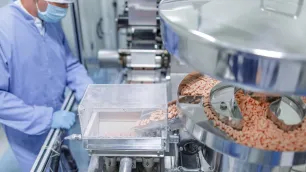
This informal CPD article ‘Cleanroom Controls in Oral Solid Dose (OSD) Manufacturing’, was provided by Pharmalliance Consulting, who offer specialist support to pharmaceutical companies to maintain and increase quality compliance levels.
When cleanrooms are discussed in pharmaceuticals, many people may immediately think of sterile injectable drugs; white-suited operators working in Grade A or B environments where aseptic precision is everything. By contrast, oral solid dose (OSD) manufacturing, with its tablets, capsules, and powders, often carries the perception of being lower risk. After all, OSD products are not sterile.
But that assumption is misleading. Cleanroom controls are just as critical in OSD facilities, though the focus shifts from microbial sterility to managing cross- contamination, protecting workers, and safeguarding product integrity.
The Unique Risks of OSD Manufacturing
OSD plants are powder-heavy environments, and powders bring two major challenges.
1. Cross-Contamination.
If traces of one active ingredient migrate into another batch, the results can be serious, exposing patients to unintended drugs or incorrect doses. This is especially concerning in multi-product facilities, where multiple APIs may be processed in parallel.
Regulators consistently flag cross-contamination as one of the most pressing risks in OSD manufacturing.
2. Operator Safety.
Many modern OSD facilities work with highly potent APIs (HPAPIs), such as oncology drugs or hormones. These compounds can be hazardous at very low levels of exposure. Without robust containment, staff may face inhalation or dermal risks. In this sense, cleanroom controls in OSD environments are not only about patient protection but also about safeguarding the workforce.
What Regulators Expect
Agencies like the FDA, EMA, and PIC/S have all underlined that OSD manufacturers must maintain strong contamination control measures.
- The FDA frequently cites facilities for poor segregation of potent compounds, inadequate cleaning validation, or weak HVAC zoning.
- EMA guidance highlights the need to design facilities in a way that reduces cross- contamination at the source, rather than relying on end-product testing.
- PIC/S inspectors have similarly stressed that relying only on cleaning between very different products is not sufficient to demonstrate control.
The message is consistent: OSD facilities may not need aseptic filling suites, but they must show that dust, residues, and product mix-ups are systemically prevented.
Key Elements of Cleanroom Control in OSD
Effective OSD cleanrooms look different from sterile suits but the principles are no less rigorous. Common controls include:
- Zoning and Segregation: Potent actives often require dedicated rooms or equipment, with physical barriers between products. Within general areas, airflow direction and pressure differentials are used to prevent powder migration.
- HVAC Systems: Air handling design is central to control. Negative pressure rooms are typically used for HPAPIs, while high-efficiency filters capture fine particles before they can spread.
- Cleaning Validation: Powders adhere to surfaces and can be difficult to remove. Validating cleaning processes, including worst-case products, hold times, and equipment types, is essential to prove that residues are consistently reduced to safe levels.
- Containment Equipment: Modern facilities increasingly use closed systems, isolators, or contained tablet presses. These reduce operator exposure while preventing actives from escaping into the wider environment.
- Material and Personnel Flows: Dedicated routes, airlocks, and clear gowning procedures minimise the risk of contamination being carried between zones.
The Human Factor
Despite the technology, people remain the most variable element in OSD cleanroom performance. A single lapse in gowning discipline, poor handling of materials, or inadequate cleaning practices can undermine even the most sophisticated systems.
This makes training and culture critical. Operators need to understand not just what procedures to follow, but why they matter. Reinforcing that even a trace of cross- contaminant could harm a patient or expose a colleague helps embed responsibility at every level.
Cost vs. Value
Some organisations still view enhanced cleanroom controls in OSD as an avoidable expense. But the costs of failure are far higher:
- Recalls linked to cross-contamination are expensive and disruptive.
- Regulatory enforcement can result in warning letters, import alerts, or shutdowns.
- Reputation is fragile, particularly in today’s transparent, consumer-driven market.
By contrast, investment in facility design, containment, and workforce training pay dividends. Strong cleanroom control reduces operational risks, increases regulatory confidence, and supports long-term growth. For manufacturers handling a broad portfolio, from generics to niche formulations with highly potent actives, these measures are not optional but essential.
Conclusion
Cleanroom controls in OSD manufacturing may not mirror the sterile world of injectables, but they are every bit as important. By preventing cross-contamination, containing potent actives, and embedding a culture of vigilance, manufacturers can protect patients, operators, and their own licence to operate.
In an environment where regulators are raising expectations and product portfolios are becoming more complex, robust contamination control is not a cost, it is a foundation for sustainable, compliant, and competitive operations.
We hope this article was helpful. For more information from Pharmalliance Consulting, please visit their CPD Member Directory page. Alternatively, you can go to CPD Industry Hubs for more articles, courses and events relevant to your Continuing Professional Development requirements.
References
The European Commission, 2022. EU Annex 1, Brussels, Belgium.
U.S. Food and Drug Administration, 2004. Part 210 – Current Good Manufacturing Practice in Manufacturing, Processing, Packaging, or Holding of Drugs, United States of America.
U.S. Food and Drug Administration, 2004. Part 211 – Current Good Manufacturing Practice for Finished Pharmaceuticals, United States of America.
European Commission, 2015. EU GMP Annex 15 – Ǫualification and Validation, Brussels, Belgium.
International Council for Harmonisation, 2023. ICH ǪS(R1) – Ǫuality Risk Management,
Geneva, Switzerland.
International Organisation for Standardization, 2015. ISO 14c44-1:2015 Cleanrooms and Associated Controlled Environments – Part 1: Classification of Air Cleanliness by Particle Concentration, Geneva, Switzerland.
International Organisation for Standardization, 2022. ISO 14c44-4:2022 Cleanrooms and Associated Controlled Environments – Part 4: Design, Construction and Start-Up, Geneva, Switzerland.
International Society for Pharmaceutical Engineering, 2024. Good Practice Guide: Heating, Ventilation & Air Conditioning (HVAC), Second Edition, United States of America.