



This informal CPD article ‘Body Equilibrium – A Physical-Clinical Interpretation of Human Upright Stability’ was provided by Dr. Mauro Lastrico, Physiotherapist at AIFiMM Formazione, an organisation recognised by the Italian Ministry of Health as an authoried CME provider. They offer organised training courses in the Mézières Method, a rehabilitative and postural approach.
Premise – Fundamentals of Muscle Mechanics
The behaviour of the muscular system follows the laws of the physics of elastic materials and provides the necessary interpretative basis for understanding the mechanics of human equilibrium [4,5]. Each muscle is composed of two components with different physical properties:
• a contractile component (actin and myosin), highly elastic and responsible for force production;
• a connective component (membranes, aponeuroses, tendons), less elastic and subject to residual deformation when exposed to prolonged mechanical loading [4,5,10].
Applying the physical laws that govern the deformation of elastic materials, it becomes evident that—depending on the force-time product of contraction—structural shortening may occur in the overall length of the muscle. This phenomenon primarily affects the connective components, which possess a lower elasticity coefficient [4,5].
These shortenings progressively modify joint geometry and the distribution of forces, increasing the muscle’s resistant force and reducing its work capacity [4,5,12]. As a consequence, the tonic-muscular control system must activate compensatory strategies to maintain alignment and ensure bodily stability [7,11].
This physical foundation supports the analysis that follows: understanding how the muscular system manages the distribution of gravitational forces in order to guarantee the stability of human equilibrium [1–3,6].
1. Gravity and Stability: Clarifying a Common Clinical Misconception
In physiotherapy practice, it is common to hear about “antigravity muscles”, as if the body had to activate specific muscle groups to oppose a force that pushes it downwards. Although widespread, this interpretation is not supported by physics nor by the biomechanics of the human body [1–3,6,12].
Gravity is not a force that compresses the body from above. It is simply the interaction between the mass of our body and that of the Earth [1–3]. It does not “push” us toward the ground: it is a constant, silent force, always present, acting in exactly the same way whether we are standing or lying down [1–3].
What prevents the body from falling is not a muscle that “resists gravity”, but the reaction force of the ground (R): a force equal and opposite to the weight force (G) that the surface exerts on us every time we are in contact with it [1–3,6]. This means that the muscular system does not have to “hold the body up against gravity”, nor does it need to generate any upward force. Its role is very different: to keep G and R aligned, so that the body remains stable with minimal energy expenditure [6,7].
If we followed Einstein’s view, we might even say that gravity is not a force at all, but rather the curvature of spacetime. However, even remaining within the Newtonian framework—perfectly sufficient for clinical practice—the conclusion does not change: the body does not need to overcome gravity; it needs to manage the vertical alignement of forces [1–3].
This leads to an important clinical implication: there are no antigravity muscles [12]. All muscles are anterior, lateral, or posterior flexors. None of them generate vertical force vectors [6]. The only ones that effectively oppose a vertical vector are the scapular adductors, but they do so by reducing the physiological thoracic kyphosis and altering the mechanics of the thoracic region [6,12].
Therefore, the idea of “strengthening antigravity muscles” has no physical basis. What is needed is not to fight gravity, but to improve segmental alignment so that G and R remain on the same vertical line [6,7].
2. Gravity and Ground Reaction: The Only Axis of Human Equilibrium
To correctly describe equilibrium, only two concepts are needed:
• G: the weight force acting downward
• R: the ground reaction force acting upward
These two forces are always present and always equal in magnitude whenever the body is still [1–3]. The muscular system therefore does not need to oppose a force to G; instead, it must manage the alignment between G and R [6]. When G and R lie on the same vertical line, the body is in a condition of stable equilibrium [1–3,6]. When they are not aligned, the body tends to fall and the muscles must intervene [6,7].
Clinically, this means that:
• the problem is not gravity
• the problem is the geometry of alignment
If skeletal segments are not aligned, the line of weight no longer passes correctly through the joint surfaces, and the muscular system must increase tone to prevent falling [6,7,11].
3. Weight Distribution: Why the Body Seeks Vertical Alignment
Body weight is not applied at a single point; rather, it is distributed across the entire support surface.
The same principle applies to any object resting on a plane [1–3]. When the weight is centred, the pressures are uniform. When the weight shifts toward an edge, a portion of the surface must bear a greater load [1–3].
In the human body, this leads to:
• increased muscular work to maintain position [6,7]
• an increase in the resistant force of the muscles involved [4,5]
• potentially harmful load concentrations at the joint level [6,9]
The neuromuscular system, moment by moment, attempts to bring the resultant of forces back toward the centre of the support polygon [6,7,11]. And it is precisely this continuous activity that determines whether the system is efficient or inefficient [6,7].
4. The Three Forms of Equilibrium: A Physical-Clinical Interpretation
Stable equilibrium
The line of weight passes through the centre of the base of support. Muscle tone is minimal, and efficiency is maximal [6].
Unstable “compensated” equilibrium
The line of weight is still within the base, but close to its edge. Muscle tone increases to prevent imbalance [6,7].
Loss of equilibrium
The line of weight moves outside the support polygon. Muscles must generate a torque to recover the body’s alignment [6,7,11].
Clinically, most chronic muscular compensations belong to the second category [11,12].
5. The Body as a System of Stacked Elements
Imagining the body as a stack of boxes helps explain alignment:
• each box has its own centre of mass [6];
• each box exerts a load on the one below it [1–3];
• overall stability depends on the vertical alignment of these centres of mass [6,7].
If a single box shifts laterally, it does not fall immediately. However, the load on the surfaces becomes concentrated, and the stack becomes less stable [6,9].
The same process occurs in the human body:
• head, thorax, pelvis, and limbs are “boxes” with their own weights [6]
• their alignment determines the quality of equilibrium [6,7]
• misalignment creates localised tensions and increases muscle tone [7,11]
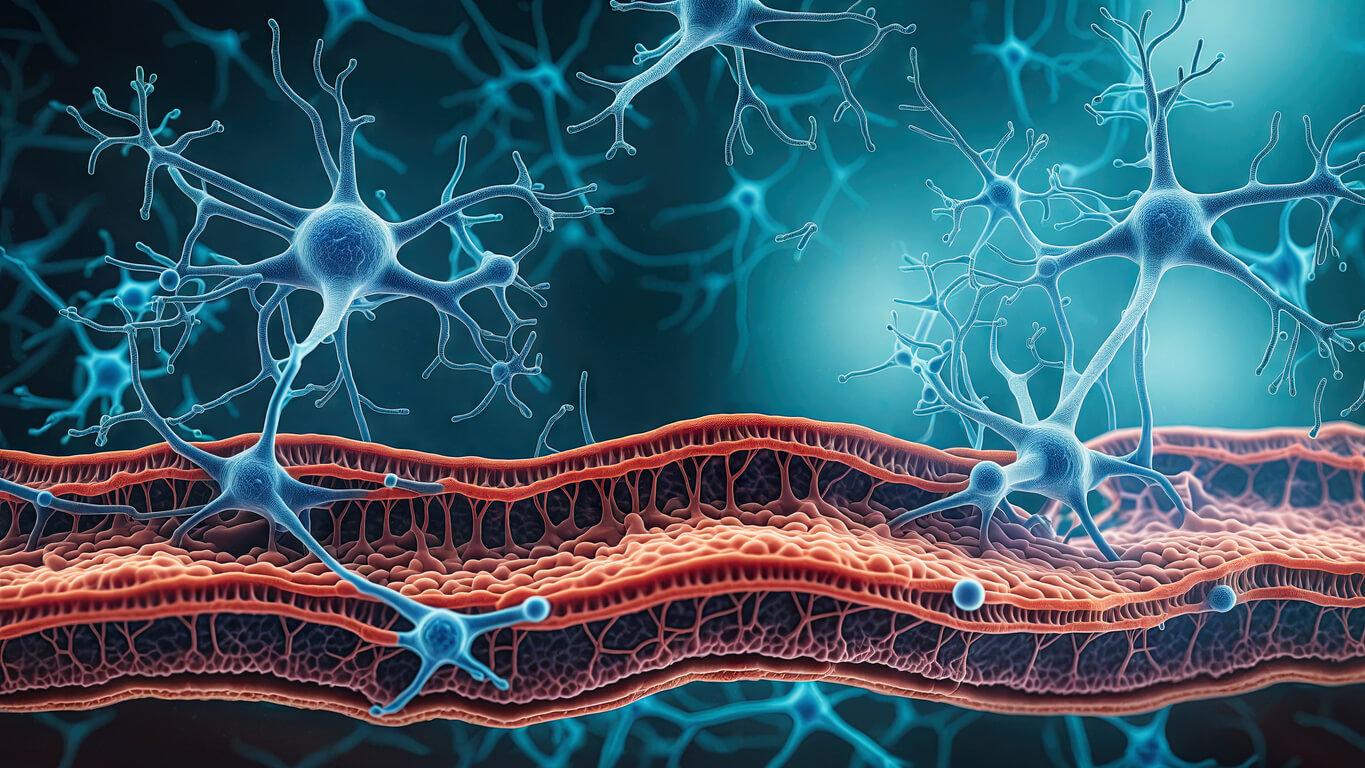
Neuromuscular System
6. Segmental Centres of Mass and the Role of the Muscular System
Each skeletal segment has its own centre of mass [6]. The sum of these determines the global centre of mass of the body [6].
The goal of the muscular system is not to lift the body, but rather to maintain the alignment between the line of weight and the ground reaction force by aligning the segmental centres of mass [6,7].
When segments are misaligned:
• load becomes concentrated on smaller surfaces [6,9]
• muscle tone must increase to prevent falling [7,11]
• joints operate under less efficient conditions [6,9]
The result is an apparent equilibrium, but one that is energetically costly [7,11].
7. An Ever-Moving Equilibrium
In standing, the body is never completely still. Breathing, physiological oscillations, and micro-variations in muscle tone continuously modify the position of the centre of mass [6,7].
The nervous system manages these variations by modulating muscle tone [7,11]. When alignment is good, this modulation is minimal. When it is not, modulation becomes significant and chronic [7].
It is this repeated tonic activity that leads to an increase in resistant force and a loss of muscular efficiency [4,5,11].
8. From Misalignment to Chronic Tone: The Link with Resistant Force
The misalignment of segmental centres of mass requires increased muscular activation to maintain equilibrium [6,7,11]. This rise in tone:
• increases resistant force [4,5]
• reduces work capacity [4,5,11]
• promotes chain-like compensatory behaviours [7,11]
• can alter the distribution of joint forces [6,9]
The patient perceives:
• stiffness [4,5]
• fatigue even during minimal activities [7,11]
• a sensation of “heaviness” in the segments that compensate [7]
• local overload [6,9]
Not because gravity has increased, but because alignment is inefficient [6].
9. Muscle Shortening as a Primary Cause of Misalignment
The muscle shortenings described in the previous article, “Muscle Shortening and Joint Dysfunction: a Physical-Clinical Explanation”, represent one of the primary causes of segmental misalignment [12].
When a muscular chain shortens:
• the skeletal segment on which it acts changes position [4,5]
• its relative centre of mass shifts [6]
• G and R are no longer aligned [1–3,6]
• the muscular system must compensate [7,11]
• load becomes concentrated over smaller surfaces [6,9]
This sequence can involve the entire body [6,7].
The shortening of a muscle group can therefore trigger a chain of adaptations. For example, if the hamstrings are shortened, the centre of mass of the pelvis may shift posteriorly relative to the vertical line passing through the medial arch of the foot, where the counterforce R is applied [6,9,12].
To maintain overall G–R equilibrium, the system automatically modulates the tone of other muscle groups, creating a sequence of alterations that affects the entire musculoskeletal system [7,11]. Equilibrium is maintained, but the neuromuscular cost increases [7,11].
Conclusions
Human equilibrium is not a muscular action, but a physical phenomenon regulated by the alignment between body weight (G) and ground reaction force (R) [1–3,6]. When skeletal segments are aligned, stability is economical and the muscular system works in conditions of maximal efficiency [6]. When they are not, muscle tone must increase to maintain verticality, with a rise in resistant force and a reduction in work capacity [4,5,7,11].
Correcting the misconception of “gravity pushing down” allows physiotherapists to interpret more accurately:
• joint misalignments [6,9]
• chronic stiffness [4,5,12]
• joint overload [6,9]
• the strategies adopted by the neuromuscular system to maintain equilibrium [7,11]
Understanding the simple physics underlying equilibrium means understanding the choices the body makes [1–3]. And it allows more targeted intervention on the alterations that arise from those choices [6,7,12].
We hope this article was helpful. For more information from AIFiMM Formazione, please visit their CPD Member Directory page. Alternatively, you can go to the CPD Industry Hubs for more articles, courses and events relevant to your Continuing Professional Development requirements.
References
- Gelenti A, Gettys WE. Fisica con fisica moderna. Milano: McGraw-Hill; 2007.
- Halliday D, Resnick R, Walker J. Fundamentals of Physics. 10th ed. Hoboken: Wiley; 2013.
- Tipler PA, Mosca G. Physics for Scientists and Engineers. 6th ed. New York: W. H. Freeman; 2008.
- Fung YC. Biomechanics: Mechanical Properties of Living Tissues. 2nd ed. New York: Springer; 1993.
- Zajac FE. Muscle and tendon: properties, models, scaling, and application to biomechanics and motor control. Crit Rev Biomed Eng. 1989;17(4):359–411.
- Winter DA. Biomechanics and Motor Control of Human Movement. 4th ed. Hoboken: Wiley; 2009.
- Shumway-Cook A, Woollacott M. Motor Control: Translating Research into Clinical Practice. 4th ed. Philadelphia: Lippincott Williams & Wilkins; 2012.
- Kapandji IA. Fisiologia articolare. 6th ed. Milano: Marrapese; 2008.
- Panjabi MM. The stabilizing system of the spine. Part I. Function, dysfunction, adaptation, and enhancement. J Spinal Disord. 1992;5(4):383–9.
- Guyton AC, Hall JE. Textbook of Medical Physiology. 13th ed. Philadelphia: Elsevier; 2016.
- Latash ML. Fundamentals of Motor Control. London: Academic Press; 2012.
- Lastrico M. Muscle Shortening and Joint Dysfunction: a Physical-Clinical Explanation. The CPD Certification Service; 2025.